Garcinias Native to Australia
Australia has 9 native Garcinia species officially recognised, not including 3 or more naturalised in last 200 years.
Botanist Wendy Cooper sorted out the taxonomy back in 2013, adding four newly described species to the list.
I'll update this post as more info becomes available.
Garcinia brassii grows up to 18m tall in the mountain rainforests from Mt Sorrow to Mt Lewis. Wounding the bark reveals a bright yellow sap, and the small yellow flowers pack a heavy clove scent.
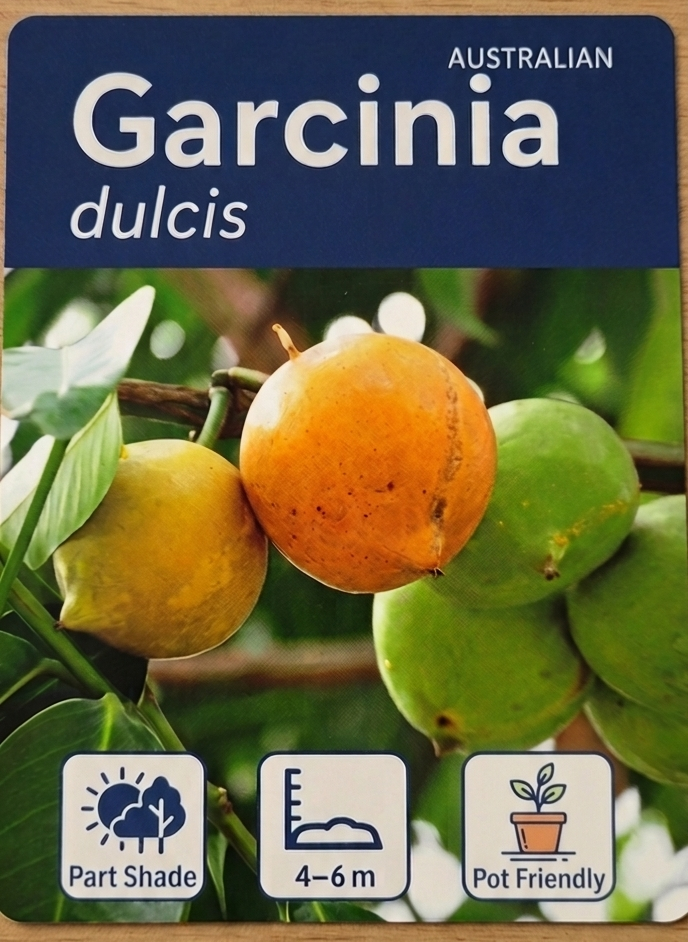
Garcinia dulcis, commonly known as mundu, yellow mangosteen, or rata fruit, is a bright yellow tropical fruit tree from Southeast Asia that is also native in tropical North Queensland.
Handles Perth well in shade and is a proven fruiter here.
Across Southeast Asia it goes by many local names, including munu in Indonesia and Malaysia, baniti in the Philippines, and maphuut in Thailand.
The species name dulcis translates to sweet, which is a bit of a botanical misnomer. The pulp leans more toward 4/10 sweet and 6/10 sour. The sharp, tangy flavour makes it a fantastic tropical alternative to lemons or tamarind, working well when eaten fresh or processed into jams, chutneys, and refreshing drinks.
Unlike many wild mangosteen species that are dioecious and need separate male and female trees to set fruit, Garcinia dulcis is self-fertile. A single tree will yield a crop once mature.
It forms a compact tree up to 15m in rainforest habitat, though it stays much smaller in cultivation. The foliage is lush and ornamental, featuring large, thick, glossy green leaves. For a tropical rainforest species, it copes surprisingly well in Perth if given a protected microclimate away from hot, drying winds and sharp winter frosts.
Sun requirements in Perth is part shade, especially protection from harsh afternoon sun in summer. Loves deep, well-draining soil rich in organic matter. Requires consistent moisture and heavy mulching.
Grows well in large containers (45L or larger) if provided with good root depth. Typically 4 to 6 years from seedling to fruiting potential. Harvest season is late summer through autumn.
Available to buy in Perth and eligible as a rebate on treebate.
Garcinia gibbsiae is a smaller understorey tree reaching 12 to 15m in high-altitude spots like Mt Bartle Frere and the Atherton Tablelands. Known as the maintain mangosteen. It bleeds a bright lime-yellow latex and has huge leaves up to 20cm long with prominent veins. Should grow well in Perth but I've never seen it here.
The fruit has a sharp, highly acidic flavour with a distinct citrusy tang. While edible, it is far more sour than most garcinias, leaning toward a tartness similar to a wild lime or lemon.
The soft white flesh around the seeds provides a juicy texture. A nice native bush food for processing into jams, sauces, or refreshing acidic drinks.
Garcinia jensenii grows up to 15m tall in deep rainforest on the Torres Strait Islands and McIlwraith Range. Named after Cape York botanist Rigel Jensen.
It produces small white flowers and fleshy round 4-5 cm fruit turning orange/red when ripe. Sharp, tangy, and acidic with a citrus-like sourness. While edible, it is mostly used for preserves, sauces, or drinks
Garcinia leggeae stays quite small, forming a multi-stemmed shrub or tree to 6m in the Iron Range region. It oozes yellow sap and puts on unusual pinkish-purple fruit when ripe. Flesh is sparse and acidic and sour.
Garcinia mestonii sits under 6m tall in high-rainfall spots between Cape Tribulation and Bellenden Ker. It forms a slender understorey tree with glossy leaves and small, 3-4cm yellow fruit. The thin layer of pulp around the seeds has a sharp, acidic tang, though it yields far less flesh than its commercial cousins.
Garcinia russellii is a critically endangered tree growing 6m tall with drooping branches.
commonly known as the Russell River mangosteen. Its flush growth puts on a show with glossy red leaves turning glossy dark green. While mainly known near the Mossman River, isolated patches also turn up near Mt Emerald at high altitude. Not found in any other country.
Like several other wild Australian Garcinia species, it holds interest among rare fruit collectors and researchers for its potential rootstock compatibility with commercial species like purple mangosteen (Garcinia mangostana) or achacha (Garcinia humilis), aiming to impart improved cold tolerance or soil adaptability.
The tree produces a small, rounded fruit about 3-5 cm. The fruit turns yellow to yellowish-orange when fully ripe, with a smooth, firm rind. Inside, the translucent white pulp surrounds several seeds.
Like most native Australian rainforest mangosteens, the flesh is sharp, acidic, and citrusy-sour.
Garcinia warrenii is the most widespread native mangosteen, ranging from Melville Island in the Northern Territory down to Babinda in Queensland. The tree reaches 25m, giving off clove-scented flowers followed by dark purple fruit with sour white flesh. Some specimens have been known to produce fairly sweet fruit. When a sweet fruiter is found its hands down the best native candidate for fresh eating. Other cultivars exist such as a large-fruited strain.
Garcinia warrenii is more readily available to rare fruit collectors. Add your name to waitlist here.
Garcinia zichii is the absolute giant of the Aussie family, growing into a 30m canopy tree in mountain rainforests. It sports sticky orange-red flower stigmas and clear to yellow resin.
Garcinia zichii is most similar to Garcinia gibbsiae and Garcinia russellii, in terms of similar producing fruit.