How Things Really Work
Ever think you know how a simple wheelbarrow works until someone asks you to fix or rebuild one? That is the illusion of explanatory depth.
We walk through life thinking we understand complex systems far better than we actually do. It's our brain's fault sparing us the pain of complex thought.
IOED isn't just about massive, complicated systems. It actually hits us hardest with the dead-simple stuff we use every day, like toilets, zippers, speedometers, and wheelbarrows.
Most of us use these basic tools without giving them a second thought, assuming we know how they work. But as soon as someone asks us to explain the exact mechanics, we realise we don't have a clue. It is a universal quirk that pops up in almost every corner of daily life.
Of course there's a little more to it than that! People usually fall into this trap for a few main reasons. First, they confuse what they know in their own heads with what everyone else knows or what they can easily look up on Google.
Second, they confuse knowing what a tool or process does with understanding how it actually works on the inside. Third, they tend to only picture the visible parts on the outside, completely ignoring the hidden mechanics tucked away within the system.
While saving mental effort plays a part in all of this, the overall illusion comes down to several overlapping reasons rather than just one single cause.
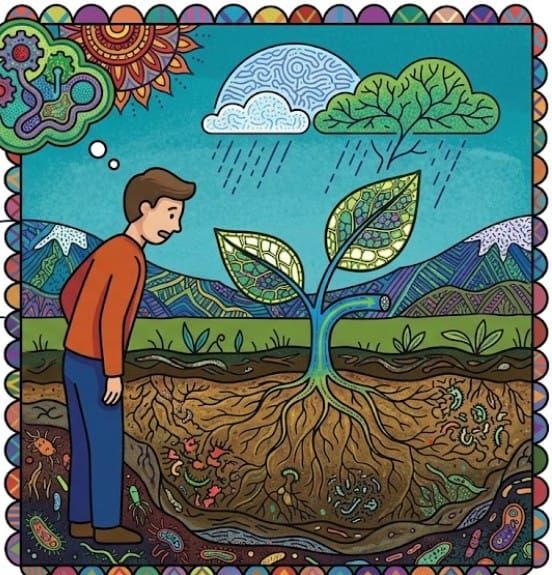
Gardens are full of this. Ask anyone how a plant grows, and they will tell you about sunlight, water, and dirt. Ask them to explain the actual mechanics of photosynthesis, root pressure, or soil biology, and the explanation falls apart pretty quickly.
Yes, you can observe and learn from nature just enough to be a better gardener. But if you truly want enlightenment turn to the complex biology of science for the nitty gritty.
There are 2 more important points not to be overlooked here:
1st - when people realise they cannot explain one simple thing, like how a zipper works, it makes them more humble across the board. They become much more open to listening to experts on completely different topics, like how the economy runs. The ripple effect goes way beyond the single thing they were trying to explain.
2nd - telling people to just turn to science for the real answers misses the mark. You do not need a degree in plant biochemistry to be a brilliant gardener. Watching how soil feels and knowing when a plant is thirsty comes from real-world practice, which is just as valuable as knowing the microscopic details.
In fact, reading a scientific fact online can actually trigger the exact same trap. It tricks us into thinking we understand something deeply just because we read a quick summary about it. The real issue isn't science versus observation. It is thinking we get how something works when we really don't.
Ask yourself, is the illusion of explanatory depth at play here in my understanding of this? It'll give you a clever way to unpack how plants and gardens actually function.
Most people take plant processes for granted because the end result looks simple. A leaf turns toward the sun, a seed turns into a tree, and rain keeps plants happy.
When you peel back the layers, the gap between what people think they know and what is actually happening is massive.... and rather insightful!
Take sunlight to sugar, for instance. People know leaves need light, but the actual process involves splitting water molecules with photons to power microscopic assembly lines.
Or consider how trees drink without a pump. Trees move hundreds of litres of water up 10+m without a heart or mechanical organ. How? Relying entirely on surface tension and evaporation from leaves... that's how.
Even soil is misunderstood. It looks like static brown dirt and dust, but a single teaspoon holds more living organisms than there are humans on Earth, operating a massive trading network with plant roots. That's why I don't recommend digging unnecessarily or using fungicides to treat leaves. You get residue on the soil and it's genocide.
How to form the habit of looking deeper? A great tip if you teach or show off your garden on social media. Take a familiar garden moment and point out the simple assumption. Then, revealing the deep mechanics underneath, is so insightful.
Of course, even before that, you got to deal with the know-it-all type of people. Maybe you are a little like that yourself.
Don't just open your eyes, open yourself to being curious and remove the assumption of knowing. For example, look at how roots find water. The simple view is that roots just grow toward moisture because they need it. The deeper reality is that plants do not have brains or eyes, so they navigate through cell division on the shady side versus the light side, gravity-sensing statoliths in root caps, and chemical signaling.
That's a big word... what are statoliths? They are tiny, dense microscopic grains inside a plant's root cells. They act like little biological spirit levels.
Because they are heavy, gravity pulls them down to the bottom of the cell. This tells the plant which way is down, so the roots know exactly which direction to grow into the dirt.
Here's another one. Leaves changing colour in autumn follow a similar pattern. People assume trees just shut down for winter and the leaves turn orange. Nope!
In reality, trees actively break down and salvage precious nitrogen and magnesium from chlorophyll before dropping the leaf. The bright red pigments are actually manufactured right at the end as a chemical sunscreen to protect the leaf while the tree drains its remaining energy.
What does this say about stripping leaves too early? It tells us that a tree is smart and wastes nothing. Leaves are filled with valuable nutrients like nitrogen and phosphorus. Autumn isn't just a leaf dying and dropping off. It's a deliberate recycling process. The tree breaks down those good nutrients, pulls them back into its trunk and roots, and saves them for fresh spring growth.
It definitely means you shouldn't strip yellow or red leaves off a deciduous plant too early.
If you yank those leaves off while they are still attached, you cut off that supply chain. You're throwing away all the stored fuel the tree was trying to suck back in. That leaves the plant with less energy saved up for its next flush of growth.
The red pigment acts like a pair of sunglasses while this happens. Bright autumn sun can damage delicate leaf tissue once the green chlorophyll breaks down. By turning red, the leaf shades itself from the harsh light just long enough for the tree to finish draining every last bit of goodness out of it.
If a leaf is still hanging on, let it stay until it falls off on its own or drops with a gentle touch.
Even something as dramatic as a Venus flytrap is purely physical engineering. People think the plant senses a bug and snaps shut like a jaw, but there are no muscles involved. The trap uses mechanical trigger hairs that count visits to prevent false alarms, triggering a rapid release of fluid pressure across cell walls to flip the leaf geometry from convex to concave in a fraction of a second.
To get in the habit of thinking at the next elevated level, start with a simple question about a mundane everyday garden occurrence. Give the brief, common answer everyone assumes is true, and then gently poke holes in it. Once the illusion breaks, walk through the actual step-by-step science in a practical, easy-to-follow way. It keeps people curious because it turns ordinary backyard plants into brilliant pieces of biological engineering. There's a reason young child geniuses have discovered things from nature that science hasn't cracked before.