Improvements for Netting Fruit Trees
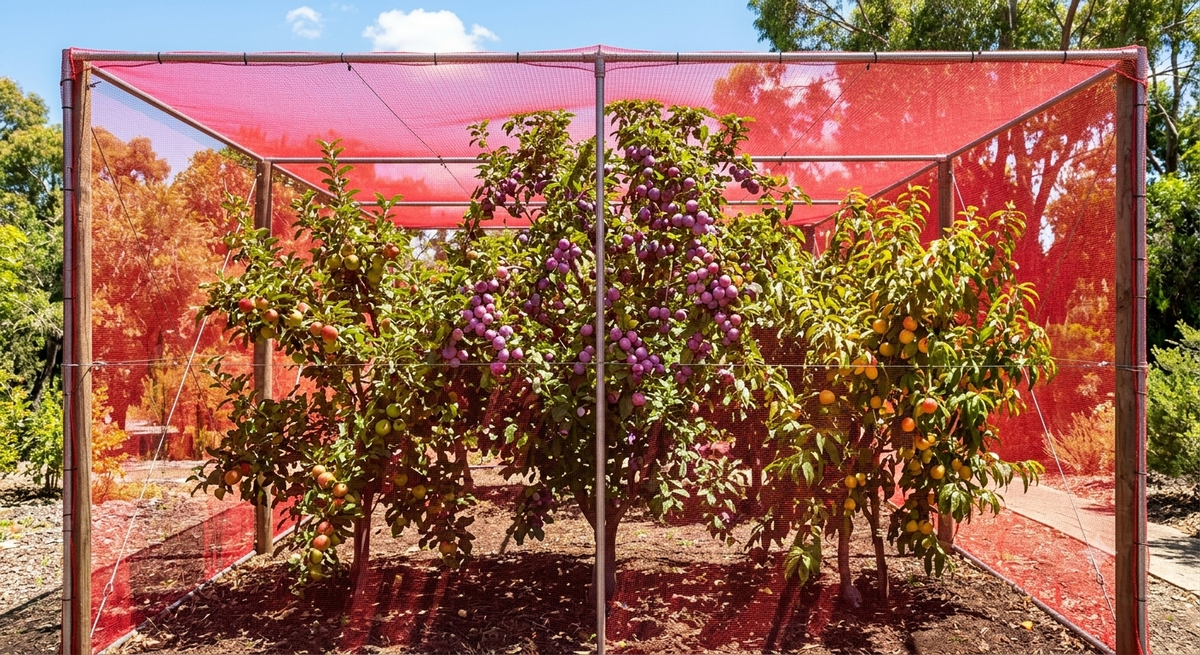
Have you ever wondered why insect fruit tree nets are white? Me neither.
Apparently there's an ideal colour that has hidden benefits. Red.
Don't you love science and research!
Research from the University of Tokyo and Kyoto Prefectural Agriculture, Forestry and Fisheries Center shows how red netting works as optical pest control.
Most insects, like thrips, aphids, fruit fly and whitefly lack red photoreceptors.
Red light at wavelengths over 600 nanometers is basically invisible to them. Instead of seeing a red barrier, the insect sees a solid dark wall or blurred light patterns that break up the visual cues of the plants underneath. Without a clear sightline to green leaves, pests do not land.
The mesh size can be larger than the insect itself while still keeping pests away. Larger holes mean better airflow, less humidity, and lower risk of fungal diseases compared to tight black or white netting. Field trials showed red nets cut pesticide spray needs by 25-50%.
What about birds?
Red netting does not trick birds the way it tricks insects. Birds have amazing eyesight and can see the color red very clearly. The bright color simply acts as a clear warning sign to them, rather than a confusing illusion.
For birds, red netting works as a regular physical fence. To keep them safe, the holes in the mesh need to be five millimetres or smaller so their heads and feet cannot get tangled. Pulling the netting super tight over a sturdy frame also stops birds from bouncing into loose folds and getting trapped. Keeping it tight protects night animals like bats and possums too, so you can keep your fruit safe without hurting any wildlife.