Macadamia Guide
The macadamia tree is one of Australia's greatest gifts to native plant culture and modern fruit growing. But it's not all Australian ingenuity.
Originating in the rich subtropical rainforests of eastern Australia, it stands as the most commercially successful Australian native plant to be domesticated and scaled into an internationally recognised gourmet crop.
While other native foods like wattleseed, lemon myrtle, and Davidson's plum have achieved commercial cultivation, the macadamia remains in a league of its own on global agricultural markets.
Native macadamias belong to the Proteaceae family, which makes them close relatives of banksias, grevilleas, and waratahs.
In the wild, four distinct species exist across southern Queensland and northern New South Wales.
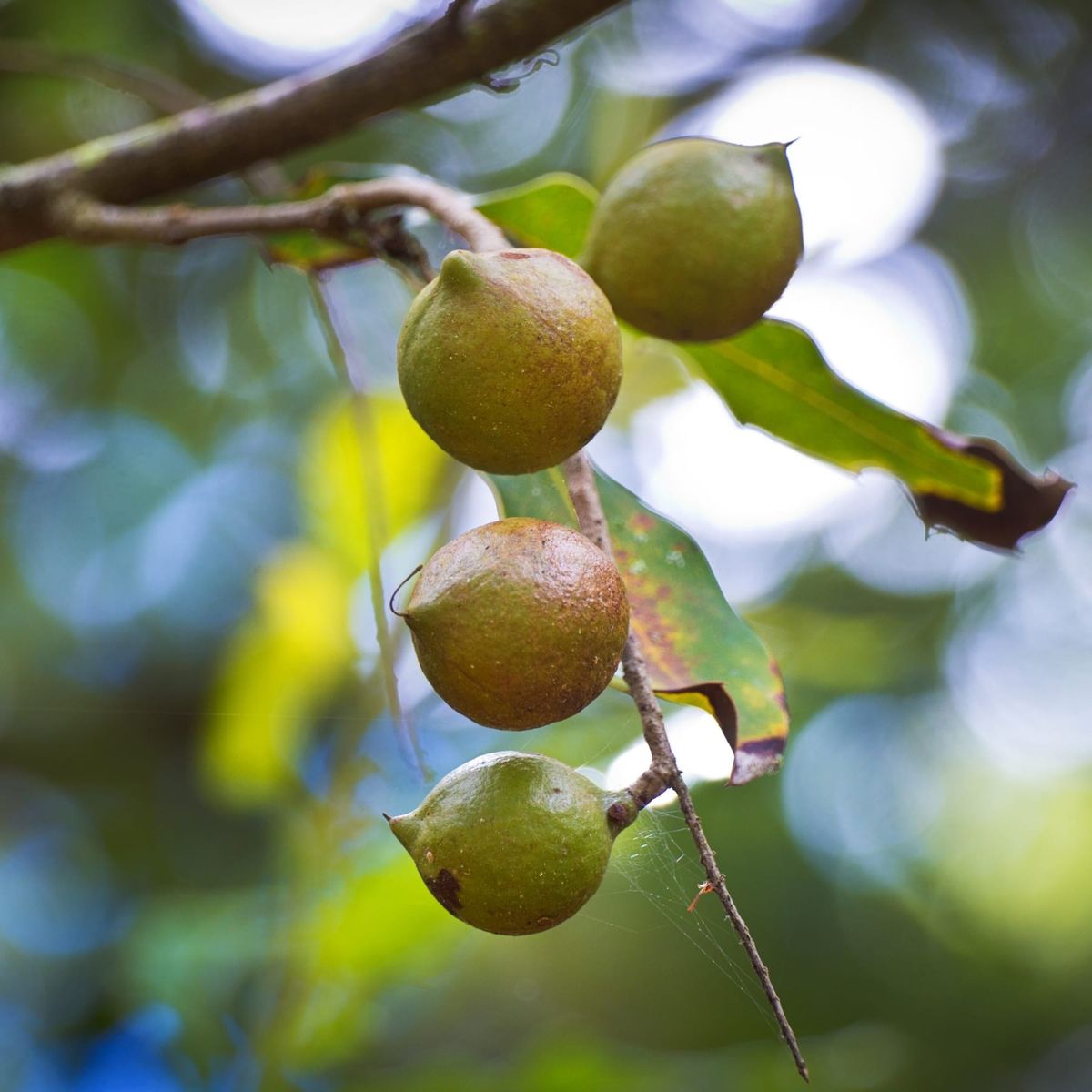
Macadamia integrifolia produces smooth shells and sweet kernels, while Macadamia tetraphylla features rough, bumpy shells with spiny leaves.
The other two wild species, Macadamia ternifolia and Macadamia jansenii, produce small, bitter nuts containing natural cyanogenic glycosides, making them inedible.
Today, wild macadamia populations in Queensland are nearly gone! Vulnerable or critically endangered due to historical land clearing, habitat fragmentation, invasive weeds, and bushfires.
Conservation groups continue to work across Queensland to map and protect these precious wild gene pools.
Long before European discovery, First Nations peoples, including the Kabi Kabi, Bundjalung, and Goomburringgir nations, gathered wild macadamias as a highly valued seasonal energy source.
Known locally as Kindal Kindal or Bauple, the nuts were harvested from the rainforest floor and cracked open using custom hammerstones on flat stone anvils. Some groups soaked or roasted the nuts prior to cracking, which made the tough shells easier to break open and helped reduce the bitterness present in certain wild varieties.
Beyond eating the rich kernels, Indigenous Australians extracted the nut oil to mix with ochre and clay for body painting, and traded the valuable nuts between coastal and inland clans.
Commercial development began in the late 19th century when botanist Walter Hill and chemist John Macadam formally documented the tree. Early Australian growers established the first cultivated orchards in New South Wales and developed initial cracking tools for the notoriously hard shells.
However, it was Hawaii that scaled the nut onto the global stage. After being introduced to the Hawaiian islands in the 1880s as windbreaks for sugarcane, Hawaiian agriculturalists spent decades developing high-yielding grafted varieties and launching global commercial brands. This created a lasting international association between Hawaii and macadamia nuts. Modern global production has since expanded dramatically, with Australia reclaiming its position as the world's leading producer alongside major commercial outputs from South Africa, China, Kenya, and Guatemala.
In terms of tree structure, growing methods play a huge role in final size. Trees grown from seed develop deep taproots, take 7-10 years to fruit, and can reach heights of 10-20 metres in the fertile soils and high rainfall of Queensland. In Perth the hot, dry summers and lighter soils mean unpruned macadamias naturally grow much slower and smaller, usually maxing out around 3-6m tall.
Cutting-grown or grafted trees stay far more compact, usually topping out at 3-5m, and fruit much faster within 3-4 years. Modern dwarf varieties have also been selected to keep trees small enough for backyard gardens and large pots around 1-3m.
To achieve maximum yields in an orchard or backyard setting, understanding pollination requirements is key. While macadamia trees produce thousands of flowers on long racemes, which are hanging, spike-like flower clusters with dozens of individual blossoms attached along one central stem.
Capable of setting some fruit on their own, most cultivars are partially self-incompatible. Planting two or more distinct cultivars close together encourages cross-pollination by bees, which significantly improves fruit set, nut size, and overall crop yields.
Growing a macadamia in Perth requires a bit of soil preparation. Macadamias prefer slightly acidic soil with a 5.5 - 6.5 pH.
Because Perth coastal sands are often alkaline, growers need to dig in plenty of organic compost, aged manure, and elemental sulfur to prevent trace element deficiencies. Sulfur is usually required on an ongoing basis due to the scheme water also being alkamline.
Young trees also appreciate protection from harsh afternoon summer sun and strong easterly winds until their roots settle in. Ideally grow in pots in shade until they reach 1.7m tall and are a little bushy.
Across all regions, climate adaptability must be considered, as young macadamia trees are particularly sensitive to frost, which can kill tender new growth or destroy an entire sapling in colder inland valleysor the Perth Hills region.
Growers must also monitor for common pests and diseases that affect commercial and backyard trees. Pest pressures include the macadamia nut borer, whose larvae bore directly into the developing nut, and various stink bug species that pierce the shell to feed on the kernel inside, leaving dark spots and bitter off-flavours.
Luckily in Perth we don't have it as bad as over East. Yes, stink bugs like the widespread southern green stink bug and local native shield bugs live in Perth. They can attack young macadamias while the husks are soft, but they cannot pierce a fully hardened shell. The most destructive pests, such as fruit-spotting bugs and the macadamia nut borer, belong to eastern Australia and are not established in WA. For Perth growers, stink bugs pose a minor threat compared to rats and cockatoos.
Fungal issues like husk spot can cause premature nut drop, while phytophthora root rot poses a lethal threat in waterlogged or poorly drained soils, causing dieback in the canopy and root decay.
The nut itself plays an interesting role for native wildlife. While the shell of a macadamia requires immense pressure to crack, select large native parrots possess the jaw power required to breach it.
In the East, large species like sulphur-crested cockatoos routinely open them. In Western Australia, where macadamias are not naturally native, local endangered species like Carnaby's Black Cockatoos have adapted to these introduced domestic trees well.
Suburban backyards and orchards now serve as a novel, highly concentrated food source for the cockatoos. Local conservation efforts, such as the Corridors for Carnabys initiative, promote planting fast-fruiting macadamia trees alongside native habitat to provide quick, high-energy food sources for travelling cockatoo flocks. In late 2026 an initiative to help Perth Metro gardens with subsidised Nut trees had been launched with a newly developed Macadamia variety. Seed grown and having the potential to fruit within 2-3 years!
When it comes to harvest timing, you should wait until mature nuts drop naturally to the ground, but prompt collection is critical. Leaving fallen nuts on the ground for too long invites rodents like rats and mice, which can gnaw through the shells, and exposes the nuts to excess moisture that causes rapid mould and rotting.
Collecting fallen nuts daily during the peak drop season preserves crop quality.
Proper drying and storage are equally important to protect your harvest. De-husk the green outer skin right away, then dry the brown shells in a cool, shady, well-ventilated spot for two to three weeks. This curing phase shrinks the kernel inside so it pops out clean when cracked using a specialised screw-press nutcracker, a bench vice, or a firm tap with a hammer on a dimpled block of wood.
Once cured or cracked, the high oil content of macadamia kernels makes them susceptible to rancidity if left exposed to heat and oxygen.
To maintain freshness, store cured in-shell nuts or shelled kernels in airtight containers inside the refrigerator for several months, or in the freezer for up to a year.
Nutritional and medical studies show that eating macadamias supports heart health by lowering total and LDL cholesterol levels. They are packed with healthy monounsaturated fats, particularly palmitoleic acid, which is an omega-7 fatty acid beneficial for metabolism.
While they are a healthy treat for humans, macadamia nuts are extremely toxic to dogs. Ingesting even tiny amounts can trigger severe weakness, vomiting, tremors, hyperthermia, and potentially life-threatening pancreatitis, meaning all nuts must be kept strictly out of reach of household pets.
It is also worth noting how macadamias compare to other tropical nuts like the candlenut. While candlenuts look similar once shelled, they belong to the spurge family and are toxic if eaten raw, requiring thorough cooking before consumption.
Macadamias, by contrast, can be enjoyed raw or roasted straight from the shell. However, growers should note that while the macadamia kernel is safe for human consumption, processing byproducts like coarse macadamia shell mulches or whole uncracked nuts can be dangerous or toxic if ingested in large quantities by certain farm livestock, such as horses.
With proper care and processing, this magnificent native species stands out as a true gem of Australian flora.
Cultivars seen in Perth:
Hawaiian Cultivars (300 and 800 Series)
Originally selected by the University of Hawaii, these Macadamia integrifolia selections feature smooth shells and upright growth habits, thriving in warm, tropical-to-subtropical environments.
344 Kau grows 5-7m with an upright habit, early flowering, and steady yields. It is partially self-fertile, setting more fruit with cross-pollination.
741 Mauka grows 4-6m with a compact canopy, high kernel quality, early blooms, and cold wind tolerance. It is highly self-fertile.
816 grows 5-7m, yielding high ratios of whole, thin-shelled white kernels. It is partially self-fertile and needs wind protection due to narrow crotches.
814 grows 4-6m with open branches, strong temperature adaptability, and high kernel recovery.
842 and 849 grow 5-6m, flowering multiple times per season for extended harvests.
Australian A-Series Cultivars
Bred by the Australian Macadamia Society and Hidden Valley Plantations for early fruiting, high yields, and storm resistance.
A4 grows 4-5m, fruiting early by year 3-4 with large nuts and high kernel recovery. It is partially self-fertile.
A16 grows 3-4m with a semi-dwarf, upright habit suited to tight orchards or home gardens. It offers storm resistance and large kernels.
A38 grows 5-6m with an open canopy, handling cooler conditions well and holding nuts until mature. It is partially self-fertile.
A268 grows 4-5m, showing fast growth, early fruiting, and thick shells.
Ornamental and Home-Garden Cultivars. Not often seen here.
Pinkalicious grows 4-6m (prunable to 3m) with vibrant pink flower racemes lasting up to six weeks and pink new growth. It is self-fertile and heavy-bearing.
Gourous grows 5-7m, producing exceptionally large nuts with high vigor in coastal spots. It is partially self-fertile.
Lotsa Nuts is a semi-dwarf growing 3-4m, bearing dense nut clusters early for backyard spaces. PBR.
Daddow grows 6-8m as a spreading, vigorous tree that sets heavy crops across varying temperatures.
Other Hybrid Cultivars
Beaumont grows 4-6m, popular in gardens for bright pink flowers, long fruiting periods, extended nut drop, and higher self-fertility.
Nelmak 2 grows 5-6m as a cold-tolerant, drought-hardy South African hybrid with mottled shells. Not often seen here.
The New Cultivar
The MCT1 cultivar is a total game changer for macadamias because it fruits in just 2-3 years instead of taking a whole decade. It grows as a compact, hardy tree with a nice manageable size, making it ideal for smaller spaces and backyards. It pumps out high yields of top quality nuts with thin husks, so you get heaps of edible kernel per shell. Best of all, every plant sale helps fund the Macadamia Conservation Trust to protect wild native macadamias in Australia.