The Great Moringa Ban of 2025
And why this was a mistake.
Have you heard the crazy news about FSANZ banning the sale of the ultimate backyard superfood, Moringa?
This has to be the most bizarre news in food science lately. Moringa is now completely illegal to import and sell as a retail food item in Australia.
In November 2025, Food Standards Australia New Zealand rejected an application to classify it as a safe food.
Border security is now officially seizing and destroying imported food-grade moringa powders and teas.
In fact, all moringa imported as retail food (fresh leaves, pods, powders, or teas) is strictly banned, seized, and destroyed at the Australian border under the Imported Food Inspection Scheme.
However, non-food moringa imports remain permitted provided they pass standard biosecurity checks: seed oil imported strictly for topical cosmetics, processed leaf powders imported as active ingredients for TGA-listed medicines, seeds imported under phytosanitary conditions for planting, and bulk plant material brought in for livestock feed or biofuel research is allowed.
Does the ban affect Perth gardeners? So here is the ultimate loophole for us gardeners, the tree itself is not a banned weed. We are completely free to grow it in our backyard and eat the leaves freely. We just can't buy or sell anything "food" on gumtree, Facebook Marketplace or the markets.
The fact that I've seen moringa leaves being sold recently through these marketplaces is simply a sign that the regulators haven't noticed or are turning a blind eye to enforcement, perhaps because they too realise it was a mistake to apply a blank moringa ban. By the way, FSANZ has provisions for this to happen:
"In Australia, state or territory government agencies and local councils are responsible for enforcing and interpreting the Code."
and it continues with this:
"FSANZ is not responsible for enforcement of the Code or for providing advice on food compliance issues. In Australia, state or territory government agencies are responsible for enforcing and interpreting the Code."
Deep Dive into The Evidence
The regulator reviewed the evidence and decided there just wasn't enough proof to guarantee safety. The rejection report highlighted what they thought to be major warning flags.
Key Reasons for Rejection:
- Unestablished Safety: FSANZ could not confirm Moringa oleifera is safe for general human consumption based on existing evidence.
- Reproductive/Abortifacient Risks: Animal studies linked leaf powder and extracts to total litter loss, embryo resorption, and pre-implantation losses, aligning with historical anecdotal reports of its use as a contraceptive or abortifacient.
- Toxicity & Genotoxicity Warnings: High doses in animal studies showed signs of liver and kidney damage, bone growth reduction, and inconclusive/positive genotoxicity results.
- Data Gaps for Pods & Oil: No relevant toxicological safety data was provided or found for green pods or seed oil.
- Cost-Benefit Balance: The potential public health risks outweighed any economic or consumer choice benefits.
Moringa Leaf is Safe!
I have questions! Why didn't they go to the other 1000s of safety studies? Why didn't they approve leaves or mature pods, for example and give at least conditional approval like they have with so many other plants before.
This is hard to swallow when you realise humans have safely eaten moringa for more than 5000 years. There are over 10,000 international studies, huge meta analyses, and massive reviews proving the leaves are highly nutritious and safe. A famous 2015 review by Stohs and Hartman checked over a hundred different human, animal, and cell studies and confirmed the leaves are very safe to eat.
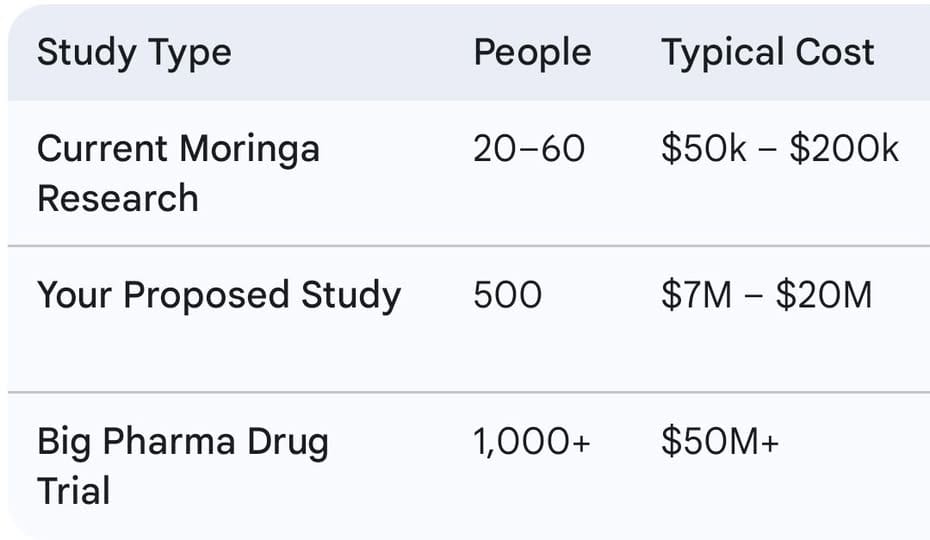
But because it wasn't a massive company that funded $100+ million dollar trial , the government applied the precautionary principle and shut ALL food sales down.
This one ruling has uprooted a massive local industry. Before this mess, the Aussie moringa market was worth $90+ million dollars and growing like a weed. One estimate put the actual import retail value at $235m USD per year!
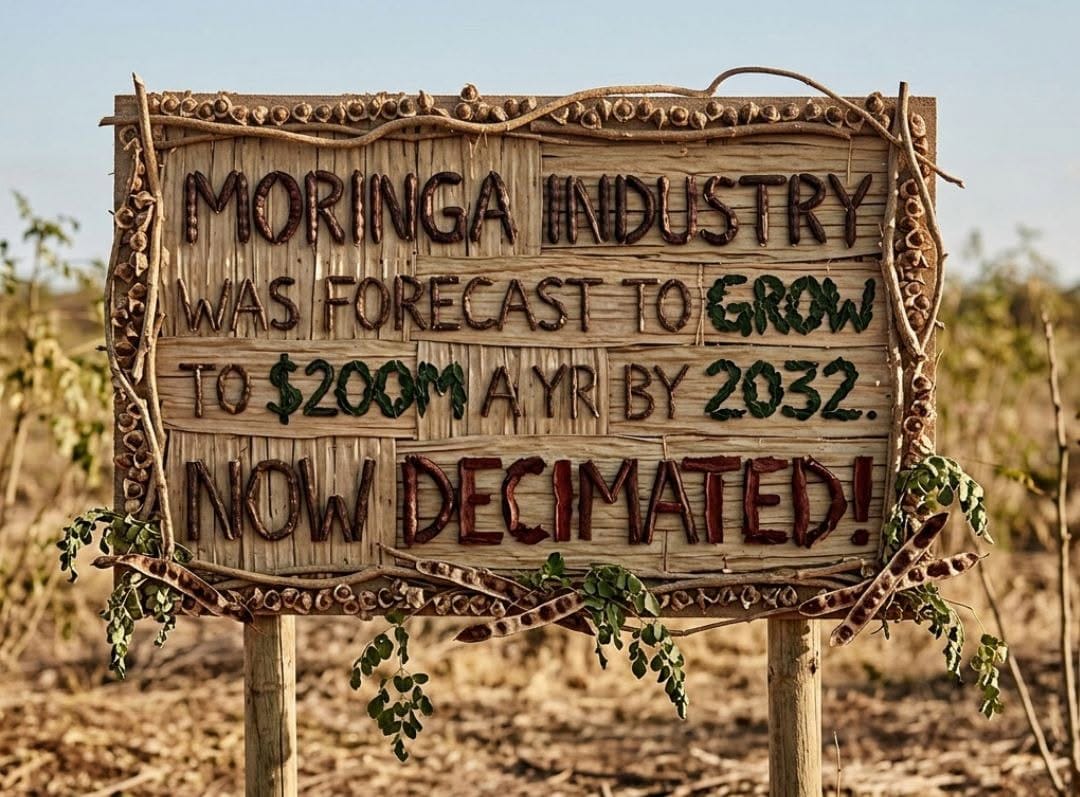
The Moringa Industry was projected to inject $200+ million into our economy by 2030. Now, commercial growers are scrambling. Since you cannot sell it as food, farmers are turning their crops into animal feed, garden tonics, and cosmetics... or shutting shop!
There's some good news. Skincare is still totally legal, and moringa oil is a massive hit because it stays fresh for ages.
It is incredibly frustrating when you look at who actually supported this plant. Heavy hitters like AgriFutures Australia, the NT Government, and the WA agriculture department all backed its safety and poured money into local crop trials. Even the 2024 Agrifutures research clearly showed it is a safe and nutritious food source. To be precise, AgriFutures funded research and supported the application, but the applicant (Noosa Organica) was responsible for submitting the safety data. FSANZ found the evidence "insufficient". Does this mean we should blame Noosa Organica or does it mean another entity needs to submit another application?
Surprising Rulings
This is what AgriFutures Australia remarked on their website about the application,
The project research clearly showed that M. oleifera is a safe and nutritious food source, suitable for human consumption. The outcome is anticipated by September 2024.
Achieving this milestone will have profound and positive impacts on the Australian and New Zealand Moringa industries.
Yet one bureaucratic hurdle has effectively killed the retail market, leaving the massive health benefits of this miracle tree exclusively to backyard hobbyists.
The History of Moringa in Australia
There's significant evidence that proves moringa has been consumed in Australia for a very long time. Some argue that only minority groups ate moringa and it never went mainstream.
It is my opinion, moringa leaf could have been classed as traditional use in Australia and if that classification was given, a ban would never have been entertained in the first place.
The definition is specific:
a "non-traditional" food is one that does not have a history of human consumption in Australia or New Zealand.
So let's examine the history of Moringa in Australia.
When talking about native plants the code sometimes mentions only non-indigenous consumption counts towards traditional uses only. I personally find that unsettling. It shouldn't matter if a food was eaten pre-colonisation or not.
In regards to moringa being naturalised. There's only one mention of this historically, so therefore most historical scholars would argue it's evidence moringa was likely introduced into Australia and never native.
Historical Mentions of Moringa oleifera in Australia
Moringa oleifera (historically known as Horse-radish Tree, Drumstick Tree, or Moringa pterygosperma) has a recorded physical presence in Australia spanning over 170 years. While herbarium specimens verify its early growth and naturalisation, newsletter archives and agricultural records confirm its domestic cultivation and consumption, particularly across tropical and subtropical regions.
19th Century: Early Botanical Introductions & Acclimatisation
- 1850s–1880s (Acclimatisation Societies & Botanic Gardens):
- Early acclimatisation societies in Queensland and New South Wales actively imported exotic utility plants from India and Southeast Asia to test their viability in local soils.
- Specimens of Moringa pterygosperma (today classed as Moringa oleifera) were established in the Brisbane Botanic Gardens and Darwin Botanic Gardens during the late 19th century as ornamental curiosities and economic plants.
- Early acclimatisation societies in Queensland and New South Wales actively imported exotic utility plants from India and Southeast Asia to test their viability in local soils.
- 1890s (Queensland Department of Agriculture Records):
- Official agricultural bulletins in Queensland documented the "Horse-radish Tree" in tropical gardens around Cooktown, Cairns, and Townsville.
- Official agricultural bulletins in Queensland documented the "Horse-radish Tree" in tropical gardens around Cooktown, Cairns, and Townsville.
- Early British settlers and Asian immigrants used the freshly scraped roots as a direct substitute for true horseradish (Armoracia rusticana) to prepare condiments.
20th Century: Herbarium Records, Cultural Migration & Local Culinary Use
- Early 1900s (South and Southeast Asian Immigrant Communities):
- Historical records from North Queensland sugarcane regions and Northern Territory pearling communities (including Broome and Darwin) document the domestic cultivation of Moringa by Indian, Malay, and Filipino workers. Immature green seed pods ("drumsticks") and young leaves were grown in backyard garden plots for traditional soups, curries, and vegetable dishes.
- Historical records from North Queensland sugarcane regions and Northern Territory pearling communities (including Broome and Darwin) document the domestic cultivation of Moringa by Indian, Malay, and Filipino workers. Immature green seed pods ("drumsticks") and young leaves were grown in backyard garden plots for traditional soups, curries, and vegetable dishes.
- 1912 (Wave Hill Station, Northern Territory):
- A preserved specimen was recorded at Wave Hill Station on the Victoria River. The collector noted that the tree was "apparently naturalised in the Northern Territory" and seemed "to thrive," establishing early wild naturalisation.
- A preserved specimen was recorded at Wave Hill Station on the Victoria River. The collector noted that the tree was "apparently naturalised in the Northern Territory" and seemed "to thrive," establishing early wild naturalisation.
- 1920s–1950s (Northern Australia Pastoral & Mission Gardens):
- Records from remote mission stations and pastoral properties across the Kimberley (WA) and Top End (NT) list Moringa as a reliable garden tree grown for shade and fresh green produce in harsh monsoonal climates.
- Records from remote mission stations and pastoral properties across the Kimberley (WA) and Top End (NT) list Moringa as a reliable garden tree grown for shade and fresh green produce in harsh monsoonal climates.
- 1964, 1975, 1994, 1995 (Queensland Herbarium Collections):
- The Queensland Herbarium holds multiple preserved specimens collected across these years, documenting the plant's long-term persistence in the state's botanical record.
- The Queensland Herbarium holds multiple preserved specimens collected across these years, documenting the plant's long-term persistence in the state's botanical record.
- 1995 (Cairns, Queensland – Rare Fruit Council of Australia):
- A newsletter article described a fruiting "Murunga" (Moringa) tree growing in a member's garden in Cairns. The entry included a detailed recipe for cooking the pods, noting they "taste just like asparagus"—providing clear, primary documentation of home cultivation and consumption.
- A newsletter article described a fruiting "Murunga" (Moringa) tree growing in a member's garden in Cairns. The entry included a detailed recipe for cooking the pods, noting they "taste just like asparagus"—providing clear, primary documentation of home cultivation and consumption.
- Undated Historical Reference (Melbourne, Victoria):
- SBS media coverage highlighted a long-time Melbourne resident who planted a Moringa tree "a long time ago" to harvest for personal culinary use and to share with neighbours, demonstrating its adoption even in southern temperate climates.
21st Century: Agricultural Research & Commercial Trials
- 2000s–2010s (Indigenous & Community Food Security Projects):
- Health and nutrition initiatives in the Northern Territory and Western Australia explored Moringa planting in remote Aboriginal communities as a fast-growing, nutrient-dense leafy green to supplement fresh food supplies.
- Health and nutrition initiatives in the Northern Territory and Western Australia explored Moringa planting in remote Aboriginal communities as a fast-growing, nutrient-dense leafy green to supplement fresh food supplies.
- 2010s–2020s (State Agricultural Departments & AgriFutures):
- NT Department of Industry, Tourism and Trade (DITT): Conducted field trials evaluating crop yields, harvest methods, and nutritional profiles of locally grown Moringa cultivars.
- WA Department of Primary Industries and Regional Development (DPIRD): Monitored nursery propagation and commercial viability for Western Australian growers in Carnarvon and the Kimberley.
- AgriFutures Australia (2022–2024): Commissioned official research reports and developed the Australian Moringa Strategic RD&E Plan, mapping domestic cultivation and backing formal safety applications to FSANZ prior to the 2025/2026 regulatory rulings.
- NT Department of Industry, Tourism and Trade (DITT): Conducted field trials evaluating crop yields, harvest methods, and nutritional profiles of locally grown Moringa cultivars.
| Group / Community | Estimated Population / Scale | Recorded Years | Consumption or Use Details |
| Colonial Settlers & Asian Immigrants | Small early settler groups & local gardeners | 1890s | Used freshly scraped roots as a horseradish substitute in Cooktown, Cairns, and Townsville. |
| South & Southeast Asian Migrants (Indian, Malay, Filipino workers) | Hundreds in sugarcane & pearling hubs | Early 1900s | Cultivated backyards in North QLD, Broome, and Darwin; cooked leaves and drumstick pods in curries and soups. |
| Pastoralists & Mission Communities | Remote stations & mission stations | 1920s–1950s | Grown in gardens across the Kimberley (WA) and Top End (NT) for fresh green produce and shade. |
| Rare Fruit Council Members | Small niche hobbyist group | 1995 | Grown in Cairns home gardens; cooked pods recorded as tasting "just like asparagus". |
| Suburban Home Gardeners | Individual home growers | Undated / Long-term | Planted trees in Melbourne gardens for personal food use and sharing with neighbours. |
| Remote Indigenous Communities | Multiple remote townships | 2000s–2010s | Sampled and grown in NT and WA community health projects as a nutrient-dense leafy green. |
| Agricultural Researchers & State Bodies (NT DITT, WA DPIRD, AgriFutures) | State field trials & commercial test sites | 2010s–2024 | Trialled crop yields, harvesting methods, and nutritional profiles across northern research plots. |
Historical Key Takeaway
Herbarium records proving naturalisation since at least 1912 and community records documenting consumption back to the 19th century.
No one is saying Moringa went mainstream and commercial before 1990s, but it's got a very clear record of consumption for more than 170 years in Australia. Giving the credence that the consumption of moringa leaf potentially should be classed as traditional use.